Four-panel comics and short updates on my writing journey. Subscribe to get content in your inbox fortnightly.
Death’s New Secretary #1
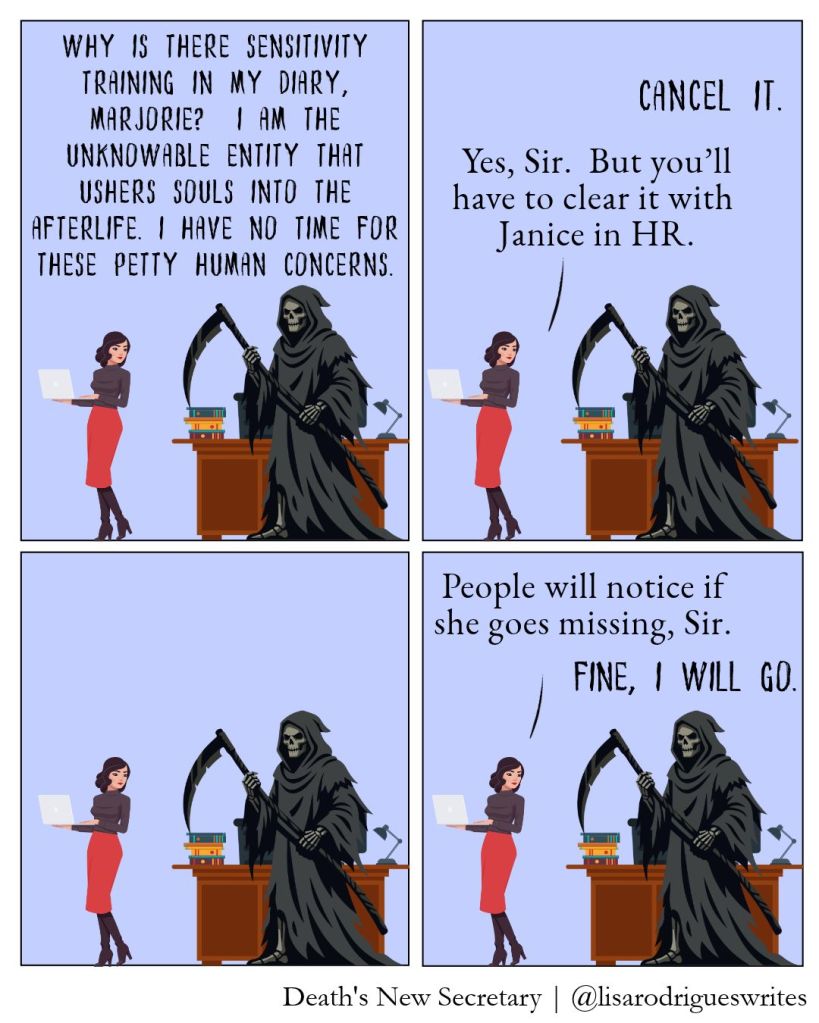
Death’s New Secretary is a comic series featuring characters from a novel in development.
Author Update
For those familiar with my previous content, I’ve realised I prefer writing fiction to writing about writing fiction. I’ll include brief updates on my writer’s journey after these comics. I am focusing on feeding my writer’s id right now.
The Plan
This financial year I’m planning to write and release nine monster romances under my indie pen name.
Why I’m writing 50,000 words books
The genre
My indie pen name, L.A. Monteiro, is known for monster romance. Monster romance is a genre that does well in short form, but readers still appreciate a full novel arc.
The algorithm
It’s also a genre that readers usually find on Kindle Unlimited, which means dealing with the zon’s algorithm, and the zon favours more releases rather than less.
50,000 words is the sweet spot, hitting the minimum length for a full novel arc without the complexity of a longer book which would take longer to write.
What I’m good at
I’m also conscious that I’m more comfortable in shorter lengths. Short novels are a great way to get better at writing complete arcs.
Why I’m writing 9 books
Business strategy
Indie publishers have different strategies that work for them. Some of them are fantastic at visual merchandising and specialise in events. Some of them write very fast and quick-release short novellas. Some of them are great at PR, and some at social media. But almost all of them agree that the best promotion is writing the next book.
My strategy is ebook and KU focused in this financial year. That means volume of pages published = higher revenue. The pages still have to be quality, the covers and blurbs have to be right, and the book has to deliver what it promises. But ultimately, the numbers matter.
To be clear, at the end of this financial year, I will almost certainly make a loss, because I use human editors and cover artists. I’m comfortable with that — in fact, it’s in my business plan. But I will have nine good assets earning for me, and my craft will be better for it.
Craft and motivational strategy
I write better with a plan and to a routine. I write better fast. I write better to a deadline — in fact, I struggle to finish manuscripts WITHOUT a deadline. But if my deadlines are too long, I get distracted and wander off on other projects. You do NOT want to look in my bottom drawer.
I also learned this year that I get better when I write two books in a row of the same length and genre. So what will happen after nine? Even if I fail in my ambitious goal, I will have learned more and written more than I ever have before.
Lifestyle strategy
I am lucky enough to be able to take six months off work in this financial year. I’ve never had that opportunity before, and I don’t want to squander it. I wanted an ambitious goal, and crunched the numbers on what I felt was realistic at my pace of writing and would set me up well for future years of publishing.
How does traditional publishing fit in?
I still have a manuscript out there in query land, and I’m a finalist in an unpublished manuscript award. I can’t control those outcomes, but I can control my own output while I hear back from other things.
When it’s hard
3 Thoughts from me
I
The idea that creative bliss naturally leads to commercial success is a stubborn myth that’s rarely true. Most working creatives I know navigate the line between following their creative bliss and catering to the market to get paid. If you’re navigating that line yourself, know you’re not alone.
II
Authors often say they need to get better at marketing. Here’s my top indie author tip – before you write the book, study at least three other books like yours. Consider genre, lengths, tropes, points of view, character type and covers. Consider what people love about these books, and what people hate. Your book should both recognisably fit in with the other books and yet stand out so someone will pick it up. Hard, right?
III
I rewrite every ending, because by the end of the first (and usually second) drafts I’m exhausted. It’s only during later edits I give it extra thought and time, tying up all the loose ends and making it completely satisfying. Apparently this is common.
2 Ideas from others
I
One titbit I remember from a romance author who penned over 100 books is that she had found no ‘right way’ to write a book. She used audio transcribing and sprints and writing in a different font and swapping locations and every hack you could think of to get words down – and she swapped methods every few books because they stopped working. She found every book hard. I find this very reassuring.
II
Here’s another snippet from The Bestseller Code by Jodie Archer and Matthew L Jockers — bestselling authors tend to focus their books on about four topics. A non-bestseller spreads to about six topics. Bestsellers tend to feel more cohesive and focused, with less unnecessary subplots. My books keep narrowing into banter and sex scenes so maybe I should just roll with that.
1 Question
When things are hard, it helps to lean into your strengths rather than focus on your weaknesses. Do you know your strengths, and are you leaning into them?
Something went wrong. Please refresh the page and/or try again.

